Who is required to carry workers compensation in Texas
Private employers in Texas are not required by state law to carry workers compensation insurance. It is elective coverage. The exceptions are public employers, government contractors, and certain industries where contracts require it.
If you choose not to carry coverage, you must notify the Texas Division of Workers Compensation in writing. You must also notify every employee at the time of hire that the company does not carry workers compensation. And you must post workplace notices, making that status visible to all employees.
Not carrying coverage is legal. What follows from that decision is where most employers run into trouble.
What happens if you don't carry coverage and an employee gets hurt
Without workers compensation, you lose the legal protections the policy provides. In Texas, an employer who carries valid workers compensation coverage is generally protected from employee lawsuits for workplace injuries. Section 408.001 of the Texas Labor Code makes workers compensation benefits the injured employee’s primary remedy against a covered employer, with limited exceptions.
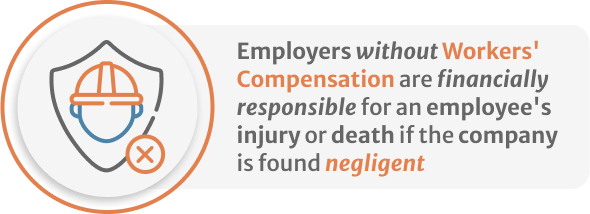
An employer without coverage does not have that protection. If an employee is injured on the job and the company is found negligent, the employer is personally liable for the full cost of that injury or death. There is no cap. Medical bills, lost wages, rehabilitation, legal fees, and any judgment in a civil lawsuit all come out of the business. Cases like that have put profitable businesses out of business.
Why Texas employers choose to carry it anyway
Most experienced Texas employers carry workers compensation even though the law doesn’t require it. Three reasons drive that decision.
Contract requirements. General contractors, municipalities, and larger clients almost universally require proof of coverage before awarding a contract. Without a certificate of insurance, you’re disqualified from those jobs regardless of your skill or price.
Legal protection. The civil liability exposure from a serious injury without coverage is open-ended. Workers compensation caps that exposure and keeps disputes inside a defined process rather than in court.
Employee retention. Workers who understand their rights expect coverage. In skilled trades especially, experienced workers factor insurance status into where they choose to work.
What Texas workers compensation covers
A standard Texas workers compensation policy covers the same categories as policies in other states. Medical expenses for work-related injuries and illnesses, including doctor visits, hospital care, prescriptions, and rehabilitation. A portion of lost wages when an employee can’t work, generally around two-thirds of their weekly wages. Job retraining if the worker can’t return to their previous role. Death benefits for the spouse and minor children of an employee killed on the job.
The policy also covers the employer’s legal defense costs if an employee files a civil claim.
Texas Mutual and dividend programs
Texas offers a unique option that most states don’t. The Texas Mutual Insurance Company is a state-created insurer that dominates the Texas workers compensation market. Businesses that place coverage with Texas Mutual and maintain a clean safety record may qualify for dividend payments at the end of the policy year. Safety groups administered through carriers like Texas Mutual can also reduce your base premium if your group’s overall claims history stays below a defined threshold.
Farmer Brown can walk you through whether a safety group or Texas Mutual placement makes sense for your business size and industry before you buy anything.
How much does Texas workers compensation cost
Texas workers compensation rates are set by the carrier, not the state, which creates more variation than in most other states. The same four factors that drive costs nationally apply in Texas.
Type of work. The NCCI class code for your employees determines the base rate. A roofer’s rate is substantially higher than an office worker’s rate.
Payroll. Premium is calculated as a rate per $100 of payroll. In Texas, rates average around $1.55 per $100 of payroll across all industries, but that number varies significantly by class code.
Claims history. Your experience modification factor compares your claims record to other businesses in the same class code. A clean record lowers your premium. Frequent claims raise it.
Safety record. Carriers look at your overall safety program when quoting. Documented safety training and incident reporting processes can work in your favor.