Workers compensation insurance
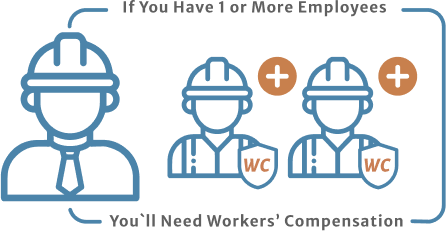
If you have employees, you need workers’ compensation insurance. Most states require coverage from the day you hire your first employee. In some states, the threshold is one employee. In others, it is three, four, or five. Coverage requirements may also apply to business partners and family members depending on your state.
Farmer Brown Insurance has been placing workers compensation policies for businesses across all 50 states since 1996. We work with A-rated carriers and get you covered the same day in most cases.
WARNING
Below you will find tips that cost other business owners serious money to learn. You get them free
Get Instant Business Owner’s Policy (BOP) Quotes Right Now!

Fill in 30 Seconds form

Receive 3 Ballpark Quotes by Email

Click on the “Talk to an Agent” button to talk with one of our pros and adjust coverages to your liking.

What Is workers’ compensation insurance?
Workers’ compensation was created to cover employees who get hurt or become ill because of their job. It pays medical expenses and a portion of lost wages while the worker recovers. It is governed by state laws. Every state runs its own workers’ compensation commission and sets its own rules.
If an employee gets injured and you don’t have coverage, you are personally responsible for those costs. If they sue and win, you pay the judgment, too. In most states, operating without workers compensation is illegal and the penalties are not small.
Additional benefits you as an employer have by having Workers’ compensation insurance
- It suggests you are a quality employer.
- You are able to attract talented employees.
- Perceived as taking care of your employee’s needs, you are able to retain quality workers for the long-term. As we all are aware retaining and finding good employees is a difficult task.
WARNING
Workers’ compensation does not automatically cover every worker on your payroll. Specific requirements must be met for a claim to be valid.
Requirements needed for an employee to receive compensation coverage benefits are:
The employer must have Worker’s Compensation Insurance
The employer must carry active workers compensation coverage. Most states make this mandatory. Without it, the employee can file a claim directly against the business.
You must be an employee as defined by federal and state laws
The worker must be classified as an employee under federal and state law. Independent contractors do not qualify. They need their own policy. Classification codes set by the National Council on Compensation Insurance (NCCI) determine how workers are categorized and what premium rate applies to each type of work. If you hire subcontractors and don't get their certificates of insurance, their payments get added to your payroll during the annual audit, and you get billed for the additional premium.
All injuries must be work-related
The injury must be work-related. An employee falling off a roof at a client's house is covered. An injury that happened off the clock is not.
PRO TIP
You need to collect Certificates of Insurance from every subcontractor before they start work. Getting them after the fact is difficult and sometimes impossible. If you can’t produce them at audit time, those subcontractor payments become your payroll, and your premium goes up accordingly.
How Does workers’ compensation insurance work?
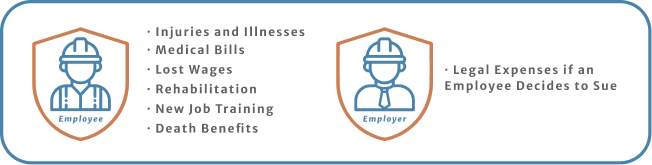
The policy covers medical expenses, rehabilitation costs, and lost wages for injured employees. It also covers death benefits if an employee is killed on the job. Most policies pay about two-thirds of the employee’s weekly wages while they are unable to work.
The policy also protects the employer. If an injured employee decides to sue, the policy covers legal expenses and any judgment.
How Workers’ Compensation Insurance claims works step by step

Healthcare professional visit
The injured employee should be seen by an approved healthcare professional. The injured employee should get medical attention immediately. Delaying treatment may cause claims for benefits to be denied. Make sure the healthcare professional knows that the injury is work-related so that the records can be properly notated.

Start the claim process
It is a employers responsibility to provide the appropriate forms, information about the claims process to the injured employee. This includes providing the contact details for the business’s Workers’ Compensation Insurance company.

File the claim
The employees should get in contact with the employer’s insurance and notify them of the claim. They should provide the insurance company any State required paperwork and medical reports. As stated earlier time is of the essence in these matters as there are strict reporting deadlines.

Getting benefits
If the claim is approved the employee will start to get Workers’ Compensation Insurance benefits. These include medical bills, rehab costs and a percentage of their wages will be paid to the employee if their injury prevents them from working.

Getting back to work
The injured employee’s doctor will determine when the employee can return to work. These recommendations might be for a reduced workload for a period of time. During this time employers should alter the work schedule of the injured employee, if necessary to allow the employee to return to work.

Safety training
Finally safety training should be provided to make sure the same type of accident does not happen again.

What does workers’ compensation insurance cover?
Workers compensation pays benefits regardless of who was at fault. An employee doesn’t have to prove the employer was negligent. A construction worker who falls off a ladder because they didn’t use proper safety equipment is still eligible for benefits.
State law determines the specific benefits available. Most states provide the following:
Medical coverage
Doctor visits, hospital care, prescriptions, physical therapy, and any other treatment the doctor orders.
Disability income
When an employee can't work, the policy replaces roughly two-thirds of their weekly wages. How long that continues depends on whether the disability is temporary or permanent, partial or total.
Job rehabilitation or retraining
Some injuries end careers. If a worker can't go back to what they were doing, the policy funds training for a different role.
Death Benefits
If an employee dies on the job, their spouse and minor children receive a death benefit payment.
To put it in a nutshell, all States provide injured workers with similar types of benefits; the amounts they pay vary greatly from State to State.
What injuries are and are not covered by workers’ compensation insurance?
Workers’ Compensation Insurance covers injuries that result from an accident at work. There are certain situations where Workers’ Comp Insurance will not provide coverage.
Coverage may also be denied in situations involving:
Injuries caused by intoxication or illegal drug use at work
If an employee was under the influence when the accident happened, the claim will be denied.
Self-inflicted injuries
If an employee intentionally hurts themselves to file a claim, the employer is not liable.
Injuries that happened off the job
If the employee was not working when they got hurt, the policy does not apply.
Injuries that resulted from violating company safety policy
If an employee violates a direct safety rule and is injured as a result, coverage may be denied.
Are volunteers covered under workers’ compensation insurance?
No. Volunteers are not paid employees and workers compensation does not cover them. In some states, immediate family members such as spouses or children may be exempt from coverage requirements. Check your state’s rules before assuming family members are automatically included or excluded. If your business uses volunteers, talk to an agent about separate coverage options. At a minimum, have volunteers sign waivers and hold-harmless agreements before they start.
PRO TIP
Another option to consider is having volunteers sign waivers and hold-harmless agreements so that they realize upfront that you are not providing coverage.
Who needs to have worker’s compensation insurance?
Every state except Texas requires businesses with employees to provide workers’ compensation. Texas makes it optional for private employers. California, New York, and Pennsylvania allow criminal charges for intentional non-compliance. Illinois fines $500 per day with a minimum fine of $10,000.
Most states require coverage when you hire your first employee. The cost of the fines and the exposure from a lawsuit both far exceed the cost of a policy.
Does a sole proprietor need workers’ compensation insurance?
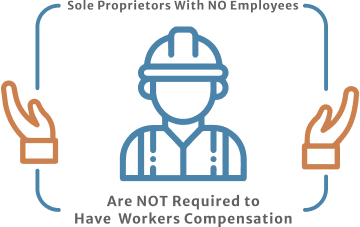
Not in most states. Sole proprietors with no employees are generally not required to carry it. But if you are injured on the job, a sole proprietor policy pays medical expenses and replaces a portion of your income while you recover. Disability insurance covers injuries regardless of where they happen. Workers compensation only covers work-related injuries. Depending on your work, one may be more cost-effective than the other.
INFO
If you are a sole proprietor is mostly likely that all your income comes from your work. If you are disabled or injured you will have no money coming in. Instead of disability insurance which can be expensive Workers’ Compensation Insurance maybe a better alternative. Remember however with Workers’ Comp you are only covered for work related injuries. With disability insurance it does not matter where the injury happened.
What if a client requires Workers Compensation and you have no employees
This is one of the most common questions we get from small contractors. A general contractor or property owner is asking for a certificate of insurance showing workers compensation coverage, but you don’t have any employees.
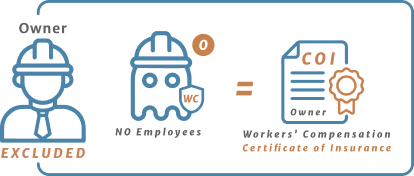
The answer is a Ghost Policy, also called an If Any policy.
The GC needs it because when their workers compensation carrier does an audit, they have to produce certificates from every subcontractor they hired. If they can’t, the money paid to that subcontractor gets classified as wages. That raises the GC’s payroll and they get billed for additional premium. To avoid that, they require everyone they hire to carry a policy.
A ghost policy runs about $1,000 per year. Pass that cost along to the client when you are pricing a job that requires it. If at audit time you can show you had no employees and you provide certificates from any subcontractors you used, you may get a partial refund on the premium.
PRO TIP
The ghost policy covers you. It does not cover your subs. If you paid a subcontractor during the year and can’t show their certificate at audit time, that money becomes your payroll. You will get a bill for it.
Workers compensation insurance in monopolistic states
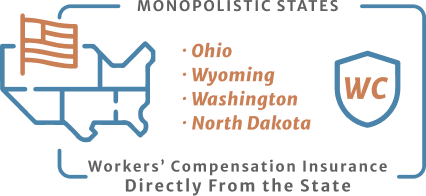
Ohio, Wyoming, Washington, and North Dakota do not allow private insurance companies to sell workers compensation. Employers in these states must buy coverage directly from the state fund.
If your business has workers in multiple states, including a monopolistic state, those workers must be insured under a separate policy purchased from the state fund. They cannot be included in a multi-state policy.
If you are in one of the four monopolistic States you need to contact the State to obtain coverage. The links for these States are below:
If you are not in one of these states, you need to determine whether or not you need to obtain Workers’ Compensation Insurance. The easiest way to do this is to contact the knowledgeable agents at FarmerBrown.com. They will listen to your needs and get you the coverage you need.
WARNING
Did You Know?
If your business employs workers in multiple States, one of which is a monopolistic state, the workers employed in the monopolistic State must be insured under a separate policy purchased from the State fund. They cannot be insured in under a multi-State workers compensation policy.
What does workers’ compensation insurance cost
Workers compensation is regulated differently by each state, which is why the price varies significantly depending on where you operate. Four factors drive the cost.

Type of business

Your location

Age of your business

Safety record or loss history
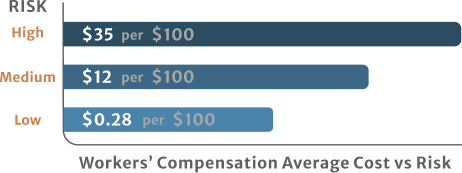
- Type of business: The National Council on Compensation Insurance (NCCI) manages more than 700 class codes that categorize types of work by risk level. Covering a roofer costs more than covering someone answering phones in an office. The table below shows what that looks like in dollars.
- Your Location: Texas runs about $13 per $100 of payroll. California can run as high as $100 per $100 of payroll for certain classifications. The more claims-heavy the state, the higher the rates.
- Age of your business: New companies often start in the Assigned Risk Pool, which carries higher rates than the standard market. As the business builds a claims history and ages out of the pool, rates come down.
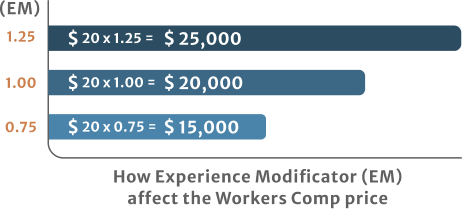
- Safety Record or Loss History: The experience modification factor, called the EM, compares your claims history to other businesses in the same class code. The average business gets an EM of 1. A poor safety record pushes it above 1. A clean record brings it below 1. That number multiplies your base premium.
Example with three general contractors, each with $100,000 in payroll at a state rate of $20 per $100:
Safety Sam GC has an EM of 0.75 and pays $15,000 per year. Average Joe GC has an EM of 1.0 and pays $20,000 per year. Risky Ralph GC has an EM of 1.25 and pays $25,000 per year.
Same coverage. Risky Ralph pays $10,000 more per year than Safety Sam. On larger payrolls that difference is significant.
PRO TIP
If your business employs workers in multiple States, one of which is a monopolistic state, the workers employed in the monopolistic State must be insured under a separate policy purchased from the State fund. They cannot be insured in under a multi-State workers compensation policy.
How much is workers’ compensation insurance for a small business?
| Description | Rate Per $100 | Amount of Payroll | Annual Cost |
| Office/Clerical | $0.13 | $40,000.00 | $52.00 |
| Painter | $8.00 | $50,000.00 | $4,000.00 |
| Roofer | $25.00 | $100,000.00 | $25,000.00 |
| Retail Store | $1.30 | $30,000.00 | $390.00 |
| Restaurant | $1.80 | $60,000.00 | $1,080.00 |
Most policies also carry a small annual administration fee set by the carrier within limits established by state law.
What medical expenses does workers compensation cover
Emergency room care, doctor visits, hospital admission, X-rays, blood tests, and rehabilitation are all covered. Diagnostic tests including MRIs are covered. Physical therapy, chiropractic care, and massage are covered but require pre-approval and have session limits.
Once a claim is approved, the insurer pays medical bills directly and keeps paying as treatment continues. Your doctor handles the pre-approval paperwork.
Benefits when a claim closes
When a claim closes, benefits can continue in three forms.
If the worker is declared permanently disabled, they receive a pension paid as a percentage of wages earned at the time of the injury. Payment frequency depends on the state.
If the disability is permanent but less than total, the worker receives weekly benefits based on the degree of disability, provided they did not settle in a structured agreement.
If the parties settle through a structured agreement, the employer pays in installments over a defined period, typically 1 to 5 years.
As a Freelancer, Do I Need Workers Compensation Insurance?
Most freelancers are independent contractors. Your workers compensation policy does not cover them. If something happens on the job, they are on their own unless they carry their own coverage.
Some states use an IRS test to determine whether a worker is actually an employee or an independent contractor. The test looks at how much control the company has over the worker’s schedule and work methods. If the result is that the worker is classified as an employee, the company is required to include them in workers compensation coverage and payroll.
Businesses that work with freelancers and do not provide coverage should have a written contract stating that the company is not responsible for injuries. They should also require the freelancer to provide proof of their own workers compensation policy.
Do You Still Have Some Questions?

Find us NOW!
We are located in 21750 Hardy Oak Blvd Ste. San Antonio, TX, 78258

Frequently Asked Questions
A place where you can find all the answers

Talk With An Agent Now
Let’s figure out how we can help you