
Taxi Insurance for commercial vehicles
In a Hurry?

Cheap commercial auto insurance for taxi cabs
A personal auto policy does not cover commercial passenger transport. Full stop. If you cause an accident while carrying a paying fare and your insurer discovers the vehicle was used for income-generating purposes, the claim gets denied. That denial can mean paying medical bills, vehicle repairs, and legal fees entirely out of pocket.

Farmer Brown Insurance has placed commercial auto insurance for taxi operators across all 50 states since 1996. Here is what taxi insurance actually covers, what it costs in 2026, and what affects your rate.
Get Instant Commercial Auto Insurance Quotes Right Now!
"*" indicates required fields
Why taxi operators need a separate commercial policy
Standard personal auto insurance excludes any use of a vehicle for hire. Personal coverage does not protect a vehicle being used for business purposes or taxi services. That exclusion applies whether you operate a traditional medallion cab, a dispatch service, or an airport shuttle. The moment a passenger pays for a ride, the personal policy no longer applies.
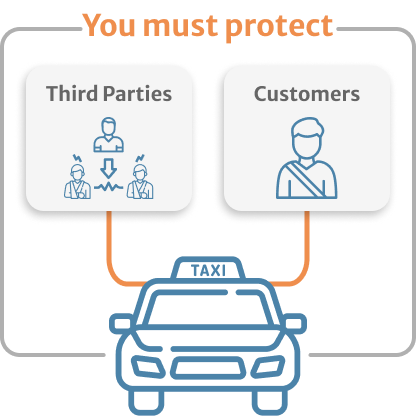
Most states and municipalities set minimum liability requirements specifically for for-hire vehicles, and those minimums are higher than standard personal auto requirements. Operating without the right commercial policy also puts your license to operate at risk, not just your insurance coverage.
What taxi insurance covers
Whether you own or lease a taxi cab, keeping your taxi fully operational is the top priority. Keeping your taxi with Taxi cab commercial auto insurance is essential in the successful operation of your business. It can also make sure there are no interruptions to your daily income.
A commercial taxi policy is built around several coverage types. Most operators need a combination of the following:
| Coverage type | What it pays for |
|---|---|
| Primary liability | Third-party bodily injury and property damage when you are at fault |
| Bodily injury liability | Medical bills, lost wages, and related costs for injured third parties |
| Property damage liability | Repair or replacement of other vehicles or property you damaged |
| Physical damage: collision | Repairs to your taxi after a collision regardless of fault |
| Physical damage: comprehensive | Theft, vandalism, fire, weather damage, and animal strikes |
| Medical payments | Medical costs for you and your passengers after an accident |
| Uninsured/underinsured motorist | Covers your costs when the at-fault driver carries no insurance or insufficient coverage |
| General liability | Required for fleet operators with employees; covers non-vehicle business liability |
| Workers compensation | Required if you have employed drivers; covers on-the-job injuries |
Owner-operators running a single cab typically need primary liability plus physical damage as the core policy. Fleet operators running dispatch services and employed drivers need general liability and workers compensation on top of the commercial auto coverage. Operators handling airport shuttles or sightseeing tours may also need endorsements for vehicle modifications or specialized equipment.
How much does taxi insurance cost in 2026?
Taxi cab insurance typically ranges from $4,800 to $9,600 per vehicle annually. The industry average runs approximately $952 per month, or $11,424 per year, with rates ranging from $551 per month in lower-cost states like Maine to $1,544 per month in New York.
Location does most of the pricing work. Dense urban markets with high accident frequency, active litigation environments, and strict municipal requirements consistently produce higher premiums than rural or suburban operations.
Taxi insurance cost by market type (single vehicle, 2026)
| Market type | Approximate monthly premium | Approximate annual cost |
|---|---|---|
| Rural / low-density states | $400 to $600 | $4,800 to $7,200 |
| Midsize cities and suburbs | $600 to $850 | $7,200 to $10,200 |
| Major metro areas (Chicago, Houston, LA) | $800 to $1,100 | $9,600 to $13,200 |
| High-cost markets (New York, San Francisco) | $1,100 to $1,544+ | $13,200 to $18,500+ |
Figures reflect standard liability plus physical damage for a single vehicle with a clean driving record. Higher limits, prior claims, or older vehicles move these numbers up.
Taxi insurance cost by fleet size (estimated annual premium)
| Fleet size | Approximate annual premium range |
|---|---|
| 1 vehicle (owner-operator) | $4,800 to $14,400 |
| 2 to 5 vehicles | $9,600 to $40,000 |
| 6 to 10 vehicles | $35,000 to $80,000+ |
| 10 to 25 vehicles | $70,000 to $200,000+ |
Fleet pricing varies significantly by market, driver records, and coverage structure. Dispatch operations with employed drivers carry additional general liability and workers compensation costs on top of commercial auto premiums.

What affects taxi insurance rates?
Driving record and claims history
Your driving record is the single most controllable factor in your premium. Carriers increasingly use telematics data and AI-based rating tools to evaluate driving behavior, and clean records qualify for better rates under those programs. One significant claim raises the renewal premium and stays on record for three to five years. Multiple claims within that window can make coverage difficult to place at standard rates.
Location and municipality requirements
Cities set their own minimum liability requirements for licensed taxi operators, and those minimums often exceed state requirements. New York, Chicago, and Los Angeles each have their own rules, and the premium reflects the local litigation environment and accident frequency.
Vehicle age and value
Physical damage coverage is priced based on the vehicle’s actual cash value. Older vehicles with lower market values cost less to insure for physical damage. Newer vehicles or those with higher replacement costs push premiums up.
Coverage limits
Most taxi insurance policies start at $100,000/$300,000/$100,000 for liability. Higher limits required by municipal contracts or client agreements increase the premium. Commercial umbrella policies are the most cost-efficient way to reach higher total limits.
Number of drivers and shift coverage
Single-driver owner-operator policies are simpler and generally cheaper to place than policies covering multiple drivers on rotating shifts. Each additional driver brings their own record into the underwriting assessment.
Owner-operators vs. fleet operators: different coverage needs
| Situation | Coverage typically required |
|---|---|
| Single cab, owner-operator only | Commercial auto liability, physical damage, uninsured motorist |
| Single cab, occasional relief driver | Commercial auto with listed driver endorsement |
| Multiple cabs, employed drivers | Commercial auto fleet policy, general liability, workers compensation |
| Dispatch service | All of the above plus non-owned auto coverage for driver-owned vehicles |
Owner-operators who lease their cab from a medallion holder need to confirm whether the medallion owner’s policy covers them or if they need their own primary liability policy. That gap is a common source of denied claims.
Owner-operators vs. fleet operators: different coverage needs
Every state sets minimum liability requirements for commercial vehicles, and most cities layer additional requirements on top for licensed taxi operators. Common municipal requirements include:
- Minimum liability limits above the state minimum, often $300,000 to $1,000,000 combined single limit
- Certificate of insurance naming the municipality or taxi authority as additional insured
- Specific policy endorsements required for airport permits or contract work
- Workers compensation if any drivers are classified as employees
Requirements vary enough between cities that what covers a Chicago cab operator may not satisfy requirements for the same operator picking up airport fares under a different permit. Verify with your local taxi authority before binding.
How to lower your taxi insurance premium
Pay the annual premium upfront. Most carriers offer a paid-in-full discount that reduces the total cost by 5 to 10 percent compared to monthly installments.
Keep driving records clean across all listed drivers. One preventable moving violation or at-fault accident affects the whole policy at renewal.
Install dash cameras and GPS tracking. Some carriers offer credits for vehicles with active monitoring because the data reduces disputed claims and fraud.
Compare quotes from multiple carriers. Stacking discounts across multiple vehicles, paid-in-full payment, and policy bundling can save 25 to 40 percent compared to a single-carrier quote.
Work with an independent agent who regularly places taxi and livery insurance. Carriers that specialize in for-hire vehicles often offer better rates to taxi operators than standard commercial auto carriers, which treat it as a secondary market.
Frequently asked questions about taxi insurance
Is personal auto insurance ever enough for a taxi driver?
No. Personal auto policies explicitly exclude commercial use. If you carry passengers for a fare and cause an accident, a personal policy will deny the claim. Most states also require a commercial policy as a condition of the taxi operating license.
Does taxi insurance cover rideshare driving as well?
Not automatically. Traditional taxi commercial auto policies and rideshare policies are structured differently. If you operate both a traditional cab and a rideshare platform like Uber or Lyft, each may require separate coverage or a combined livery insurance policy. Other for-hire operations may need separate endorsements depending on the service offered. Confirm with your agent before operating both under a single policy.
What is the difference between primary liability and general liability for taxi operators?
Primary liability covers vehicle accidents where you are at fault. General liability covers non-vehicle business claims, such as a passenger injured getting out of the cab on a slippery sidewalk or a slip and fall at your dispatch office. Fleet operators and dispatch services generally need both. Solo owner-operators usually only need primary commercial auto liability.
How quickly can I get taxi insurance coverage?
Farmer Brown can bind same-day coverage for most taxi operators across all 50 states. A certificate of insurance is available within four hours of binding in most cases.
What happens if one of my drivers gets into an accident?
If the driver is listed on the policy and was operating within the scope of covered use, the commercial auto policy responds. If the other driver is uninsured or underinsured, that portion of the policy covers the gap. Unlisted drivers or drivers operating outside covered use can create coverage issues. All regular drivers should be listed on the policy at inception.
Want to know everything about Contractors Insurance with updated information?
This E-book is for you!
Do you still have some questions?

Find us NOW!
We are located in 21750 Hardy Oak Blvd Ste. San Antonio, TX, 78258

Frequently Asked Questions
A place where you can find all the answers

Talk With An Agent Now
Let’s figure out how we can help you