
Roofing Insurance for Contractors
Fast Quotes. Trusted Coverage. Call (888) 973-0016
We have GREAT AUTO/HOME RATES!

Progressive Insurance
6300 Wilson Mills Rd, Mayfield Village, OH 44143

GEICO (Government Employees Insurance Company)
5260 Western Avenue, Chevy Chase, MD 20815
We cover all 50 States!
Roofing insurance for contractors
Roofing is the most dangerous trade in construction. Fall fatalities in this trade are not a statistic people debate. They show up in the data every year, consistently worse than almost any other occupation. That risk profile is exactly why roofing insurance costs more than most contractor trades and why standard contractor policies often exclude or limit coverage for roofing work.
One fall, one property damage claim from a tile dropped on a client’s car, one worker who can’t return after a knee injury. Any of those events without the right coverage can cost more than a roofing company makes in a year.
What Is roofing contractor insurance?
Roofing contractor insurance is not a single policy. It is a combination of policies that together cover the range of risks a roofing business faces. Standard contractor policies are frequently not adequate for roofing work. Carriers that write general contractors often exclude roofing from their policies or add endorsements that limit coverage for work above a certain height. Getting the right combination matters as much as having any coverage at all.
The core policies every roofing contractor needs are general liability, workers compensation, and commercial auto. Around those, most roofing companies also carry inland marine for tools and equipment and a commercial umbrella to meet higher limits required by commercial clients.
Why insurance is important for roofing contractors
Roofing insurance coverage is not a single policy. It is a combination of protections designed to cover the most common risks associated with roofing operations and contracting services.
General liability insurance for roofers
General liability insurance covers third-party bodily injury and property damage caused by your operations. For roofing contractors, the most common claims are property damage from falling materials, damage to a client’s interior from a leak during the job, and injuries to people on or near the job site who are not your employees.
Completed operations coverage within general liability is especially important for roofers. Roof failures, leak-backs, and installation defects often show up months or years after the job. A homeowner whose ceiling collapses two seasons after a new roof was installed will file a claim under your completed operations coverage. Make sure it is included in your policy and not sublimited.
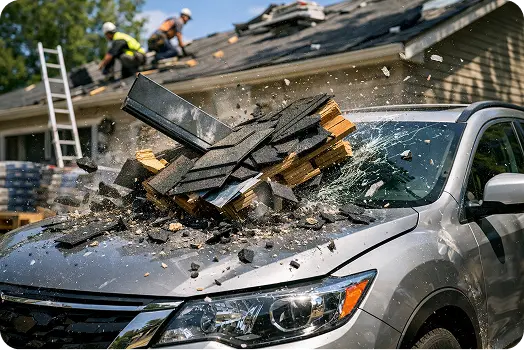
Most commercial property owners and general contractors require roofing subcontractors to carry at minimum $1,000,000 per occurrence and $2,000,000 aggregate, with the client named as additional insured. Without that certificate, you do not get on the job site.
General liability for roofing contractors averages about $3,200 per year, or roughly $267 per month. Smaller operations start at the $2,800 minimum premium.
Workers’ compensation iInsurance for roofers
Workers compensation is required in every state except Texas for businesses with employees. For roofing contractors, it is the policy that carries the most weight because roofing injuries are frequent and serious.
Falls from roofs and ladders. Nail gun injuries. Heat exhaustion on summer jobs. Back injuries from lifting shingles and handling debris. These are not theoretical risks. They happen on roofing jobs regularly, and when they do, workers compensation covers medical expenses, rehabilitation costs, and a portion of lost wages while the worker recovers. It also provides death benefits for families of workers killed on the job.
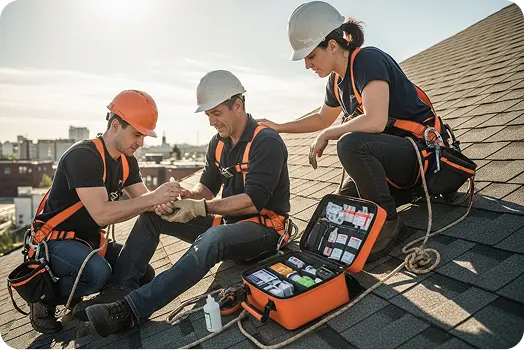
When an employee accepts workers compensation benefits, they generally waive the right to sue the employer for that injury. For roofing contractors whose employees work in genuinely dangerous conditions every day, that legal protection is significant.
Workers compensation rates for roofers are among the highest of any trade. The experience modification rate, or EMR, measures your claims record against other roofing businesses in the same classification. A clean record keeps the EMR below 1.0 and directly lowers your premium at renewal. A single serious fall claim can push the EMR above 1.0 and raise your costs 20% to 30% for the next three years.
Commercial auto insurance
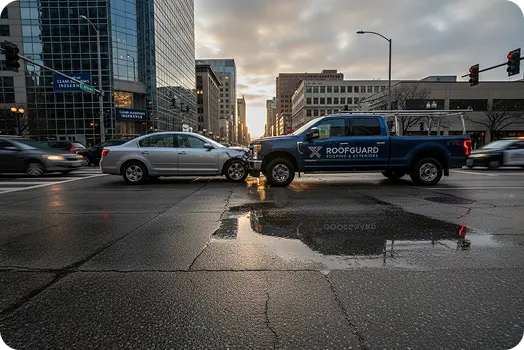
If your crew uses trucks or vans to transport equipment, materials, or workers to job sites, personal auto insurance will not cover an accident that happens during a work trip. Commercial auto insurance covers vehicles owned by the business, employees who drive those vehicles, and in most policies employees who use their personal vehicles for work.
For roofing contractors running multiple crews to multiple job sites daily, fleet coverage is typically more cost-effective than individual commercial auto policies. A truck loaded with roofing materials involved in an accident generates claims that personal auto carriers will decline. Commercial auto for roofing contractors averages about $2,075 per year per vehicle.
Inland marine for tools and equipment
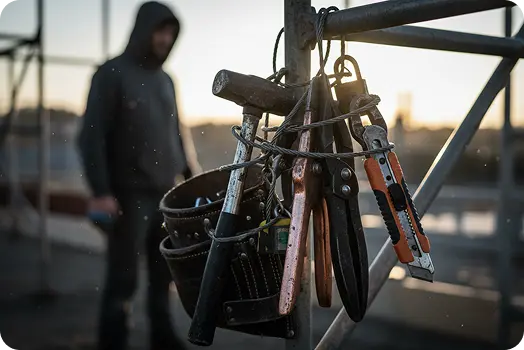
Roofing equipment is expensive and frequently stolen. Air compressors, nail guns, fall protection equipment, roofing jacks, and staging all get left on job sites overnight. Inland marine insurance follows the equipment wherever it goes: on the job site, in transit, or in a truck overnight. A standard property policy only covers equipment at a fixed location.
Coverage is typically written at Replacement Cost Value, meaning the policy pays the cost to replace the equipment new rather than its depreciated cash value. On tools that wear fast in roofing conditions, RCV is worth having. A small roofing operation typically pays around $800 per year for inland marine coverage.
Commercial umbrella insurance for roofers
A commercial umbrella extends your liability coverage above the limits of your underlying general liability and commercial auto policies. When a claim exceeds your $1,000,000 per occurrence limit, the umbrella picks up the difference.
Commercial property owners and general contractors on larger projects frequently require $2,000,000 or $5,000,000 in total coverage. A $1,000,000 general liability policy with a $1,000,000 umbrella gets you to $2,000,000. A $4,000,000 umbrella gets you to $5,000,000. The umbrella is typically the cheapest way to reach those higher limits and costs a few hundred dollars per year for most roofing operations.

Roofing insurance requirements by state
Every state where you operate has its own licensing and insurance requirements for roofing contractors. Some require proof of general liability before issuing a license. Most require workers compensation from the first employee. Florida, California, and New York have some of the most specific requirements in the country.
Operating without required coverage can result in license suspension, fines, and personal liability for any claim that occurs while the business is out of compliance. If you work across multiple states, each state’s requirements apply independently.
In addition, clients such as general contractors, commercial property owners, and municipalities often require:

Proof of general liability insurance

Workers’ compensation certificates

Certificates of insurance issued before work begins

Specific coverage limits
Failing to meet roofing insurance requirements can delay projects, disqualify bids, or expose your business to fines and legal issues.
How much does roofing insurance cost in 2026
Roofing is one of the highest-rated contractor trades, and insurance pricing reflects that. General liability runs approximately 1% of annual revenue.
Roofing Contractors General Liability (1% of revenue)
These figures are for general liability only. Workers compensation is typically the largest single line item in a roofing insurance program and is priced separately based on payroll and state. Commercial auto, inland marine, and bonds add further to the total.
| Annual Revenue | Estimated Annual Premium |
|---|---|
| Under $150,000 | $2,800 minimum |
| $150,000 to $500,000 | $2,800 to $5,000 |
| $500,000 to $1,000,000 | $5,000 to $10,000 |
| $1,000,000 to $5,000,000 | $10,000 to $50,000 |
Residential versus commercial roofing
Commercial flat roofing on large structures is rated higher than residential steep-slope work. The claims from commercial roofing jobs are larger on average.
Height and fall exposure
The higher the average working height, the more likely carriers are to surcharge the policy. High-rise commercial roofing carries higher rates than standard residential work.
Steep-slope versus flat roofing
Steep-slope residential work has a higher fall risk. Low-slope commercial roofing may carry greater property damage exposure because leaks can damage entire building interiors.
Claims history
Roofing insurance is heavily experience-rated. A single serious fall claim or a large water damage claim can raise your premium 25% to 50% at renewal. Five years without a claim is the most valuable thing a roofing contractor can bring to market when shopping coverage.
Subcontractor exposure
Roofing companies that use a high percentage of subcontracted labor face higher premiums unless those subs carry their own documented coverage.
State regulations
Florida, California, and Texas all have specific roofing contractor insurance requirements that affect pricing and what must be filed before a license is issued.
Why roofing contractors choose Farmer Brown
Roofing is one of the hardest contractor classes to place well. Many carriers write it reluctantly and load the policy with exclusions that gut coverage. We know which markets write roofing seriously, what the policy actually needs to include, and what to watch for in the exclusions before you sign.
We cover all 50 states, issue same-day certificates at no charge, and quote general liability, workers compensation, commercial auto, inland marine, and bonds together so you see what the full program costs before you commit to anything.
What sets Farmer Brown apart:

Experience insuring roofing contractors nationwide
Fast certificates of insurance for jobs and bids
Clear explanations of insurance coverage and exclusions
Assistance meeting state and client insurance requirements
Competitive roofing insurance rates from multiple carriers
Frequently asked questions
Do roofers need workers compensation insurance?
Yes, in every state except Texas. Even in Texas, most commercial clients require proof of workers compensation before awarding a roofing contract. Given the injury rates in this trade, operating without it is a significant financial exposure regardless of what state law requires.
Is general liability enough for a roofing contractor?
No. General liability covers third-party claims but does not cover employee injuries, vehicle accidents, or equipment theft. Most roofing operations need general liability, workers compensation, and commercial auto at minimum. Inland marine for tools and an umbrella for higher limits are common additions.
How fast can I get a certificate of insurance?
Same day in most cases. Farmer Brown issues certificates within hours of binding coverage. If you need a certificate to bid a job tomorrow, call (888) 973-0016 today.
Can I get roofing insurance with no prior coverage?
Usually yes. Most new roofing businesses get placed without much trouble. If you have had a lapse or a bad claim in the past, some carriers walk. We have markets for those situations that most agencies cannot access.
Want to know everything about Contractors Insurance with updated information?
This E-book is for you!
Do you still have some questions?

Find us NOW!
We are located in 21750 Hardy Oak Blvd Ste. San Antonio, TX, 78258

Frequently Asked Questions
A place where you can find all the answers

Talk With An Agent Now
Let’s figure out how we can help you