
Builders Risk Insurance
Builders Risk Insurance and Course of Construction Insurance
Standard property insurance stops covering a building the moment construction starts. That’s true for renovations and for ground-up builds. As soon as work begins, that coverage disappears. Builders risk insurance fills the gap. It covers the structure, the materials, and the equipment on site from the first day of work until the project is done.
Farmer Brown Insurance places the top five builders risk policies that together account for 95% of all builders risk coverage written in the United States. We cover all 50 states, work with A-rated carriers, and get quotes back the same day in most cases.
Before you read the rates: they do not include wind coverage for buildings within 50 miles of the coast. If your project is in a coastal zone, submit it and we will send you the correct pricing separately.
What is Builders Risk Insurance
Builders Risk and Course of Construction are two names for the same policy. It is a property policy that covers a structure during construction or renovation. When the project finishes and the property is ready for occupancy, the policy ends. That window is the only thing it covers, which is what makes it different from a standard property policy.
The coverage includes the structure itself, materials stored on site and in transit, soft costs tied to construction delays, debris removal, and often temporary structures like scaffolding. It is not a liability policy. General liability insurance and workers compensation are separate requirements and are not included here. Earthquakes and floods are also excluded from a standard policy unless you add them specifically.
How much does Builders Risk Insurance cost
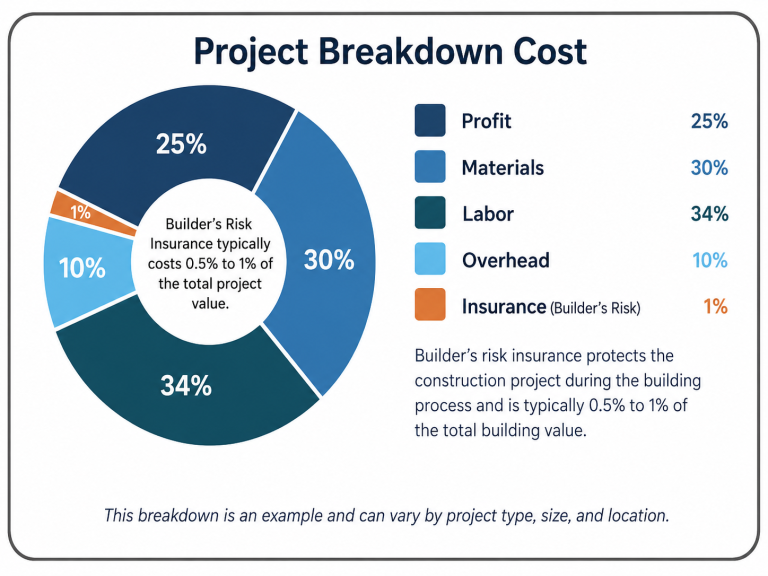
Small projects can start around $375 in most states. For larger projects, the cost generally ranges from 1% to 5% of the total construction value, depending on the project’s size, duration, and selected coverage.
Two benchmarks that are useful for bidding:
New construction runs about $0.30 per $100 of construction value. A $500,000 new build costs roughly $1,500 per year in builders risk premium.
Renovation and rehab projects run about $0.65 per $100 of construction value. Existing structures carry more risk than new builds. A $300,000 gut rehab costs roughly $1,950 per year.
Two external requirements worth knowing before you start: lenders and financial institutions frequently require proof of coverage as a condition for approving a construction loan. Many municipalities require it before issuing a building permit. Have the policy in place before you break ground.
Factors affecting the cost of coverage:

Type of project
New construction and renovation are rated differently. A renovation on an occupied building costs more to insure than an empty lot. Projects with significant structural changes, like converting a warehouse into apartments or restoring a historic structure to current code, carry higher premiums than straightforward builds.

Construction Value
Higher value means higher premium. Custom materials, high-grade finishes, and complex mechanical installations all push the number up.

Location
Coastal properties, flood zones, and high-crime areas carry surcharges. Anything within 50 miles of the coast needs separate wind coverage that a standard policy won't include.

What you're covering
A basic policy covers fire, theft, vandalism, and wind. Adding earthquake, flood, off-site materials, soft costs, and debris removal increases the premium. Each one also protects against a category of loss that can easily exceed the cost of the extension on a large project.

Existing structures
A basic policy covers fire, theft, vandalism, and wind. Adding earthquake, flood, off-site materials, soft costs, and debris removal increases the premium. Each one also protects against a category of loss that can easily exceed the cost of the extension on a large project.

How far along the project is
Projects that are more than 30% complete at the time of application typically require additional underwriting. Get the policy in place before work starts.

Materials in transit
If materials are being stored off-site or are still in transit, you need coverage that follows them. That is an additional line on the policy and is worth including on any project where materials are staged away from the job site.

What does builder’s risk insurance cover?
Standard builders risk coverage includes fire, smoke, and explosion. Theft and vandalism. Vehicle and aircraft impact. Wind damage, subject to coastal limitations. Lightning. Hail. Soft costs, such as architectural fees, permit costs, and financing charges, that accrue when a covered loss delays the project.
Standard exclusions: earthquakes and floods require separate endorsements. Employee dishonesty and criminal acts are excluded. Faulty workmanship and design errors are excluded. Tools and equipment owned by subcontractors are excluded. Bodily injury and property damage to third parties require a separate general liability policy.
WARNING
Read the exclusions before the project starts. That is where claims get denied. An agent who reviews your policy specifics upfront costs nothing. A denied claim on a $2 million project costs everything.
Who Builder’s Risk Insurance covers?
Anyone with money in the project needs to be on it. The property owner, the general contractor, the lender, and in some cases subcontractors. The construction contract usually specifies who buys the policy. If it doesn’t, the property owner or GC typically takes responsibility.
Projects where builders’ risk is appropriate: residential new construction, commercial new construction, full gut rehabs, additions to existing structures, and partial renovations where only a section of the building is being worked on.
Builder’s risk for new construction vs. renovation
The difference matters more than most people realize.

New Construction
The policy covers site preparation, excavation, foundations, framing, pipes, electrical work, and temporary structures. It starts with groundbreaking and ends when the certificate of occupancy is issued.

Renovation
Two structures are in play: the work being done and the building that was already there. A renovation policy can be written to cover only the new work or both the new work and the existing structure. If it is written to cover only the new work and a fire damages both the renovation and the existing building, you have a gap. That gap can be expensive.
Before any renovation, ask your agent specifically how the policy handles the existing structure and the new work as separate exposures. Get that answer in writing before signing anything.
Type of business and why they might need builders risk insurance

Builders
- For coverage of ground-up construction of a site
- Reimbursement of stolen or damaged materials
- Fire, wind, or water damage
- Vandalism of site or equipment

Contractors
- Reimbursement of stolen or damaged materials
- Reimbursement of stolen or damaged equipment
- Fire, wind, or water damage
- Vandalism of site or equipment

Retail Companies
- Protection of your construction site in strip-malls or other owned buildings
- Protection of construction of the independent site

School District
- Coverage of additions built onto the school
- Coverage of recreation structures
- Coverage of tools
- Coverage of equipment
Builder’s risk for homeowners
A homeowner’s policy does not cover construction. A demolish-and-rebuild, a major addition, or a gut renovation all fall outside its design. Losses that happen during construction are excluded.
A residential builders risk policy runs for the length of the project and ends when construction is complete and the property is occupied. Coverage limits and exclusions for residential projects differ from those for commercial projects. The specifics matter, so review them with your agent before the project starts.
Why the carrier you choose matters
A claim that takes three months to resolve can delay project completion, trigger contract penalties, and cost more in carrying costs than the original loss. Speed of claims handling is not a minor consideration on a construction project.
Farmer Brown places builders risk with carriers that know the construction industry and pay claims fast. We work with the five largest builders risk writers in the country, which together write 95% of all builders risk policies in the United States. Better pricing and carriers that can handle a large commercial project without the runaround.
Common builder’s risk policy extensions
Standard policy terms are 3 months, 6 months, or 1 year. Extensions are available when projects run past their original completion date.
Debris removal
A covered storm event triggers repairs. It does not always trigger debris hauling. Industrial dumpster rental alone runs $900 or more. A debris removal extension covers disposal after a covered loss.
Pollutant cleanup
A fire or explosion can rupture containers holding paint, solvents, tar, or other hazardous materials. Cleanup costs are significant and a standard policy won’t cover them. If your project involves materials that could contaminate soil or groundwater, add this extension.
Delay of completion
A covered event delays the project. The delay costs money. This extension compensates for revenue lost because the building wasn’t finished on time. It can also cover non-construction expenses that pile up during the delay, including architectural fees, permits, and financing costs. On any commercial project where the completed building was expected to generate revenue, this one is worth pricing out.
Water buildup
Clogged pipes, roof penetrations, and weekend flooding are among the most expensive renovation claims. The extension is cheap. The claims it prevents are not.
Green building
If the project uses sustainable materials or renewable energy systems, a standard policy replaces them with conventional equivalents after a loss. This extension replaces them with equivalent sustainable materials instead.
Start-up and commissioning
For projects involving new machinery or complex building systems, coverage can extend into the start-up and commissioning phase. That covers the period between construction completion and full operation, when new systems often fail for the first time.
Why choose Farmer Brown for builder’s risk insurance
We have placed builders’ risk policies for contractors, developers, and property owners since 1996. It is one of our highest-volume product lines. We are licensed in all 50 states, work in English and Spanish, and issue certificates in under 4 hours.
We quote from at least three carriers, so you see real options before you decide. Our agents go through your project before recommending anything.
Do you still have some questions?

Find us NOW!
We are located in 21750 Hardy Oak Blvd Ste. San Antonio, TX, 78258

Frequently Asked Questions
A place where you can find all the answers

Talk With An Agent Now
Let’s figure out how we can help you