
Restaurant Insurance:
A Complete Guide for Restaurant Owners
Call (888) 973-0016 and Get Insured Today!
We have GREAT AUTO/HOME RATES!

Progressive Insurance
6300 Wilson Mills Rd, Mayfield Village, OH 44143

GEICO (Government Employees Insurance Company)
5260 Western Avenue, Chevy Chase, MD 20815
We cover all 50 States!
“Running a restaurant is brutal. Long hours, thin margins, staff turnover, and now you have to figure out insurance too. We have been doing this since 1996. This guide will save you time and probably some money. Read it once and you will know more than most restaurant owners ever bother to learn.”
From John M. Brown, Founder and CEO, Farmer Brown Insurance

Table of Contents
What Restaurant Insurance Actually Covers
Running a restaurant is brutal. Long hours, thin margins, staff turnover, and now you have to figure out insurance too. We have been doing this since 1996. This guide will save you time and probably some money. Read it once and you will know more than most restaurant owners ever bother to learn.
The six core coverage types for a restaurant:
| Coverage | What It Protects Against |
|---|---|
| General liability | Customer injuries, property damage, advertising claims |
| Workers compensation | Employee injuries and illness on the job |
| Commercial property | Building, equipment, inventory, lost income |
| Commercial auto | Vehicles used for business purposes |
| Liquor liability | Claims from alcohol served to customers |
| Commercial umbrella | Losses that exceed underlying policy limits |
Most restaurant owners need all six. The question is not whether to buy them but how to price them correctly and avoid gaps between policies.
A Business Owners Policy (BOP) can bundle general liability and commercial property into one package, usually at a lower combined price than buying them separately. Workers compensation and commercial auto have to be purchased as standalone policies regardless.
Restaurant General Liability Insurance
Restaurant liability insurance is the most fundamental coverage a food service business can carry. A single slip-and-fall lawsuit, even a frivolous one, can cost $50,000 in legal fees before a settlement is ever discussed.
General liability covers four categories of claims:

Customer bodily injury
If a guest is hurt on the premises, the policy covers medical expenses, attorney fees, court judgments, and settlements. Slip-and-falls, food-related illness, burns from hot surfaces, and injuries from equipment all fall here. The policy also pays legal defense costs even when the claim turns out to be groundless.

Customer property damage
A server who spills a bowl of lobster bisque on a $3,000 fur coat just created a claim. General liability covers the replacement cost, legal fees if the guest sues, and any settlement. The coverage extends off-site too. A catering crew whose equipment starts a fire at a private event has coverage for any resulting property damage claim, provided the policy is written correctly.

Host liquor liability
Standard general liability policies include coverage for alcohol served at a private event where no money changes hands. A staff holiday party where wine is provided falls here. This is not the same as liquor liability insurance, which covers commercial alcohol sales. Restaurant owners who sell alcohol need both, not just one.

Advertising injuries
If a restaurant’s logo or tagline accidentally copies a competitor’s, general liability covers copyright infringement, libel, and slander claims.
What General Liability Costs
Restaurant insurance cost for a general liability policy varies by revenue, location, number of seats, and the type of operation. Here is what most restaurants actually pay:
| Restaurant Type | Annual Premium Range |
|---|---|
| Small cafe or bakery (under $500K revenue) | $800 - $1,200 |
| Mid-size full-service restaurant | $1,000 - $2,500 |
| High-volume restaurant or bar | $2,000 - $4,000 |
| Food truck | $1,200 - $2,000 |
| Multi-location operation | $3,000 - $8,000+ |
The national average for restaurant general liability insurance runs around $1,000 per year, or roughly $90 per month. Most policies carry $1 million per occurrence and $2 million aggregate limits. Bumping limits from $1 million to $2 million per occurrence typically adds $200 to $400 per year, which is worth considering for any restaurant doing significant volume.
The cost of restaurant insurance also changes based on claims history. One major claim in the past three years can push renewal premiums up 20 to 40 percent.
At FarmerBrown.com, restaurant owners get same-day quotes. Call (888) 973-0016 or go to farmerbrown.com.
Workers Compensation Insurance
Workers compensation pays medical bills and a portion of lost wages when an employee is injured on the job. It applies regardless of who was at fault. The injured cook who slips because they rushed and did not use a mat still has a valid claim.
State law requires it in nearly every state. The premium is entirely the employer’s cost.
Employees contribute nothing.
What it covers:
Medical treatment is the biggest bucket. Doctor visits, emergency care, surgery, prescriptions, physical therapy, and any follow-up care deemed medically necessary. There is no deductible for the employee.
Disability income replaces a portion of wages when an injury keeps someone out of work. In most states, that amount is approximately two-thirds of the worker’s regular weekly pay. How long those payments continue depends on whether the disability is temporary or permanent, partial or total.
Job rehabilitation covers retraining costs for workers who cannot return to their previous role due to a permanent injury.
Death benefits go to the spouse and minor children of an employee killed on the job.
What it does not cover:
- Self-inflicted injuries
- Injuries that occur off the clock and off premises
- Injuries from conduct that violated company policy
- Injuries that result from intoxication or drug use at the time of the accident
- Injuries that occur while committing a serious crime
How a claim actually works:
The injured employee reports the injury to the employer immediately. Every state has a filing deadline, and missing it can void coverage. The employee sees an approved healthcare provider and makes sure the records reflect that the injury is work-related. The employer provides the claim forms and the insurer’s contact information. The employee submits the paperwork to the carrier. If approved, benefits start. The treating physician sets the return-to-work timeline.
Speed matters on both sides. Delayed reporting causes problems. Delayed treatment causes problems and weakens the claim.
Workers Comp Class Codes and Pricing
How Class Codes Work
Workers compensation pricing is built on classification codes developed by the National Council on Compensation Insurance (NCCI). Every type of work has a code. Each code carries a base rate that reflects the injury risk of that work.
A restaurant has multiple codes because it has multiple types of employees. The line cook and the bookkeeper are not the same risk. Putting all payroll under the higher-risk code, which some insurers or agents do by mistake or by habit, means overpaying.

The three primary codes for restaurants:
| Class Code | Type of Operation | Risk Level |
|---|---|---|
| 9082 | Full-service restaurants with tipped servers | Moderate |
| 9083 | Fast food restaurants | Moderate |
| 9084 | Bars, nightclubs, and taverns (50%+ revenue from alcohol) | Higher |
Office and administrative staff at any of these operations belong in a separate, lower-risk code. A receptionist or bookkeeper should never be rolled into kitchen payroll.
Most states follow NCCI codes. The exceptions: California, New York, Massachusetts, Pennsylvania, Minnesota, New Jersey, Indiana, Wisconsin, Delaware, Michigan, and North Carolina operate under independent bureau systems. Washington, North Dakota, Wyoming, and Ohio prohibit private workers comp insurance altogether.
Experience Modification
Beyond the class code, the single biggest variable in workers comp pricing is the experience modification factor (EM). It compares a business’s actual claims history against the expected claims for similar businesses. The baseline is 1.0.
A restaurant below 1.0 has a better-than-average safety record. A restaurant above 1.0 has a worse one. The EM multiplies directly into the premium.
What the EM means in actual dollars (base rate $2.00 per $100 of payroll, $300,000 payroll):
| Restaurant | EM | Annual Workers Comp Premium |
|---|---|---|
| Strong safety record | 0.75 | $4,500 |
| Industry average | 1.00 | $6,000 |
| Poor claims history | 1.25 | $7,500 |
On a $1 million payroll, the gap between a 0.75 and a 1.25 EM is $5,000 per year. Safety programs are not just good practice. They are a direct cost reduction.
What Workers Comp Costs for Restaurants
Workers compensation runs approximately $2,000 per year for every $100,000 in payroll, using typical restaurant class codes. The per-$100-of-payroll rate ranges from $0.80 to $2.50 depending on the state and the specific code.
Approximate annual workers comp premiums by payroll size:
| Annual Payroll | Low Range (0.80/100) | Mid Range (1.50/100) | High Range (2.50/100) |
|---|---|---|---|
| $100,000 | $800 | $1,500 | $2,500 |
| $250,000 | $2,000 | $3,750 | $6,250 |
| $500,000 | $4,000 | $7,500 | $12,500 |
| $1,000,000 | $8,000 | $15,000 | $25,000 |
New businesses usually land in the state’s assigned risk pool while they build a claims history. Assigned risk rates run higher than the standard market, often 20 to 30 percent more.
Workers Comp Audits
Workers comp premiums are estimated at policy inception based on projected payroll. The insurer audits actual payroll at the end of the policy year and adjusts the final premium accordingly. Low-risk operations face one audit per year. High-risk or new businesses can face quarterly audits.
If actual payroll came in higher than the estimate, the business owes the difference. If it came in lower, the insurer issues a credit. The audit itself is straightforward as long as the original estimate was reasonable and payroll records are in order.
Restaurant Property Insurance
A restaurant is a capital-intensive business. The commercial kitchen equipment alone in a mid-size operation can cost $150,000 or more to replace. Property insurance protects that investment.

Building coverage
Building coverage applies when the restaurant owns the physical structure. It covers damage from fire, storms, vandalism, and other named perils. Tenants leasing their space do not need building coverage. Their landlord’s policy covers the shell. What tenants do need is contents coverage.

Contents coverage
Contents coverage handles everything inside the four walls: kitchen equipment, tables, chairs, point-of-sale systems, the tenant buildout. Specialty or high-value equipment may need a separate endorsement to be covered at full replacement cost rather than depreciated value.

Equipment breakdown coverage
Equipment breakdown coverage pays repair or replacement costs when mechanical systems fail. A commercial refrigeration failure on a Friday night is not a covered event under standard property insurance. Equipment breakdown coverage is. It can also compensate for lost income during the downtime.

Food spoilage coverage
Food spoilage coverage reimburses the cost of food inventory lost to a power outage or refrigeration failure. A single overnight outage can destroy thousands of dollars of perishable product. This coverage costs relatively little and prevents a bad situation from becoming a financial one.

Business interruption insurance
Business interruption insurance is the coverage most restaurant owners wish they had bought after a fire or major loss forces a temporary closure. It replaces lost income during the period the business cannot operate.
Here is the math that makes it necessary: a kitchen fire with $40,000 in physical damage can close a restaurant for two to four months while repairs and permits are sorted. At $30,000 per month in lost revenue, the income loss alone reaches $60,000 to $120,000. The property claim covers the repairs. Only business interruption coverage addresses the income loss.
What Workers Comp Costs for Restaurants
| Item | What It Pays |
|---|---|
| Lost net income | Revenue the business would have earned, based on prior financial statements |
| Fixed operating costs | Rent, utilities, loan payments, and other ongoing expenses |
| Temporary relocation | Extra costs of operating from a temporary location |
| Extra expenses | Costs incurred specifically to resume normal operations faster |
Restaurant Commercial Auto Insurance
Who Actually Needs It
Personal auto insurance excludes business use. That exclusion is not buried in fine print. It is a standard policy condition. A restaurant owner who uses their personal vehicle to pick up supplies, make deliveries, or drive to a catering job has no coverage from their personal policy if an accident happens during that trip.
The same applies to employees. An employee who drives their personal car to pick up a produce order for the restaurant is doing business driving. Their personal insurance will likely deny a claim from that trip.
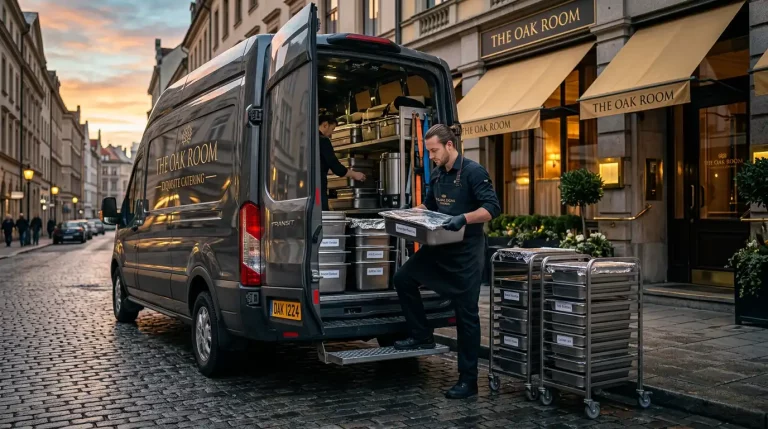
Any restaurant with delivery drivers, catering vehicles, food trucks, or company cars needs commercial auto coverage.
What It Covers
Commercial auto insurance for restaurants covers most of the same categories as a personal policy, with business-specific provisions added:
| Coverage Type | What It Does |
|---|---|
| Property damage liability | Pays for damage to other vehicles or property; covers legal defense costs |
| Bodily injury liability | Covers injuries to others in a covered accident, plus legal fees |
| Medical payments | Covers driver and passenger medical costs regardless of fault |
| Comprehensive | Covers theft, vandalism, weather damage, and non-collision events |
| Collision | Pays for vehicle repairs after an accident, up to actual cash value |
| Uninsured/underinsured motorist | Pays when the at-fault driver has no insurance or not enough |
Two endorsements worth adding to any restaurant commercial auto policy:
- Hired auto coverage protects against claims from leased, rented, or borrowed vehicles used for business purposes.
- Non-owned auto coverage covers employees using their personal vehicles for business errands, such as supply runs or bank deposits.
What Commercial Auto Costs for Restaurants
| Vehicle Type | Approximate Annual Premium |
|---|---|
| Standard car or SUV | $2,200 |
| Delivery or cargo van | $3,500 |
| Food truck (owner-operator) | $9,500 |
| Fleet of 5+ vehicles | Varies; fleet pricing often lower per unit |
Location changes these numbers significantly. A New Jersey restaurant typically pays two to three times what the same operation would pay in Texas. Manhattan restaurants pay more than upstate New York restaurants. Urban density, traffic volume, and state liability laws all factor in.
Recommended minimum coverage limits are $500,000 per vehicle. A $1 million limit is preferred for delivery operations. If a delivery driver causes an accident and the judgment comes in at $900,000, a $500,000 policy leaves the owner personally responsible for the remaining $400,000.
A note on gap insurance: for any leased or financed vehicle, gap insurance covers the difference between what is owed on the loan and the vehicle’s actual cash value at the time of a total loss. Without it, the owner pays the lender the shortfall out of pocket.
Valet Insurance
Parking lots generate more claims than most restaurant owners expect. When a valet service is involved, the restaurant takes custody of the customer’s vehicle. What happens to that vehicle from the moment the key is handed over is the restaurant’s responsibility.
Two operating models, two different insurance setups:

When the restaurant employs its own valet staff
When the restaurant employs its own valet staff, it carries full liability for vehicle damage, driver accidents, and anything else that happens while the car is in its possession. The necessary coverages are general liability, garage auto insurance (which specifically covers vehicles in the restaurant’s care, custody, and control), workers compensation for the valet employees, and employee dishonesty coverage for theft from inside customer vehicles.

When the restaurant outsources to a professional valet company
A server who spills a bowl of lobster bisque on a $3,000 fur coat just created a claim. General liability covers the replacement cost, legal fees if the guest sues, and any settlement. The coverage extends off-site too. A catering crew whose equipment starts a fire at a private event has coverage for any resulting property damage claim, provided the policy is written correctly.
Garage auto liability insurance is the coverage most restaurant owners miss. Standard general liability does not cover a valet driver who backs a customer’s BMW into a concrete pillar. Garage auto coverage does.
Liquor Liability Insurance
What It Is and Why It Is Separate
Liquor liability insurance, also called dram shop insurance, covers claims that arise from alcohol a restaurant sold or served to a customer. It is not included in a standard general liability policy. Host liquor liability, which does come with general liability, only covers events where alcohol is given away, not sold commercially.
Any restaurant that sells alcohol needs a separate liquor liability policy or a liquor liability endorsement added to its general liability or BOP.
What It Covers
| Claim Type | Example |
|---|---|
| Assault and battery | A customer who was served alcohol injures another guest |
| Drunk driving | An intoxicated patron leaves and causes a car accident |
| Property damage | An intoxicated customer damages another person's property |
In states with dram shop laws, a business that serves alcohol to a visibly intoxicated person and that person then injures a third party can be held directly liable. Judgments in these cases have reached seven figures. Every state with a dram shop law also requires liquor liability coverage as a condition of the alcohol license.
What Liquor Liability Costs
The average cost of liquor liability insurance for a full-service restaurant where food is the primary revenue source runs around $1,000 per year. A bar or nightclub where alcohol represents the majority of sales pays considerably more.
| Establishment Type | Approximate Annual Premium |
|---|---|
| Restaurant (alcohol under 30% of sales) | $800 - $1,500 |
| Restaurant/bar (alcohol 30–50% of sales) | $1,500 - $3,000 |
| Bar or tavern (alcohol over 50% of sales) | $3,000 - $6,000+ |
| Nightclub with high volume | $5,000 - $10,000+ |
Other factors that affect the price: the state, coverage limits, annual liquor revenue, and whether staff holds documented alcohol server training certifications. A Responsible Beverage Service training program costs a few hundred dollars and can reduce premiums by more than it costs.
Business Owners Policy (BOP)
A BOP combines general liability and commercial property insurance into one policy. For small to mid-size restaurants, it typically costs less than buying the two coverages separately, and it simplifies renewal and claims management.
Not every restaurant qualifies. Insurers generally require that the business be under a certain revenue threshold, occupy a building below a certain size, and present a relatively standard risk profile. A high-volume bar with a history of assault and battery claims will not qualify.
Workers compensation and commercial auto still need to be purchased separately. A BOP does not touch those.

Endorsements that can be added to a BOP:
- Liquor liability
- Food contamination coverage
- Equipment breakdown
- Business interruption insurance
- Cyber liability (relevant for any restaurant storing customer payment card data)
Approximate BOP cost for restaurants:
| Revenue | Approximate Annual BOP Premium |
|---|---|
| Under $500,000 | $1,500 - $3,000 |
| $500,000 - $1 million | $2,500 - $5,000 |
| $1 million - $3 million | $4,000 - $8,000 |
| Over $3 million | Usually priced as separate GL and property policies |
Commercial Umbrella Insurance
A commercial umbrella policy sits on top of the underlying liability policies, general liability and workers compensation, and pays when a judgment or settlement exceeds those base limits.
Coverage is sold in $1 million increments. Most restaurants carry between $1 million and $5 million in umbrella coverage. A $1 million umbrella policy costs a few hundred dollars per year, making it among the cheaper coverage types relative to the protection it provides.
The umbrella only pays after the underlying policy is exhausted. If a restaurant carries $1 million in general liability and faces a $2.2 million judgment, the GL policy pays $1 million and the umbrella policy covers the remaining $1.2 million. Without the umbrella, the restaurant owner pays $1.2 million directly.

When a commercial umbrella makes sense:
| Factor | Threshold |
|---|---|
| Annual revenue | Over $3 million |
| Physical assets (equipment, real estate) | Significant owned property |
| Delivery or catering operations | High vehicle exposure |
| Liquor sales | Dram shop state with high-volume sales |
In states with dram shop laws, a business that serves alcohol to a visibly intoxicated person and that person then injures a third party can be held directly liable. Judgments in these cases have reached seven figures. Every state with a dram shop law also requires liquor liability coverage as a condition of the alcohol license.
Commercial Umbrella Insurance
The cost of insurance for a restaurant is fixed. The cost of an uninsured loss is not.
A workers comp claim from a kitchen burn can run $40,000. A liquor liability judgment in a dram shop state can reach $2 million. A three-month closure after a kitchen fire can wipe out more revenue than the physical repair claim. These are not edge cases. They are routine events in the food service industry.
The restaurant owners who consistently pay less for insurance coverage over time do a few specific things differently. They classify employees correctly and keep payroll records accurate. They invest in safety programs that reduce their experience modification below 1.0. They bundle coverages where it makes financial sense. They work with an independent broker who places policies with multiple A-rated carriers rather than a single captive insurer.
Farmer Brown Insurance has been writing restaurant insurance since 1996. Same-day quotes, all 50 states, bilingual English and Spanish service.
Do You Still Have Some Questions?
Want to know everything about Contractors Insurance with updated information?
This E-book is for you!