




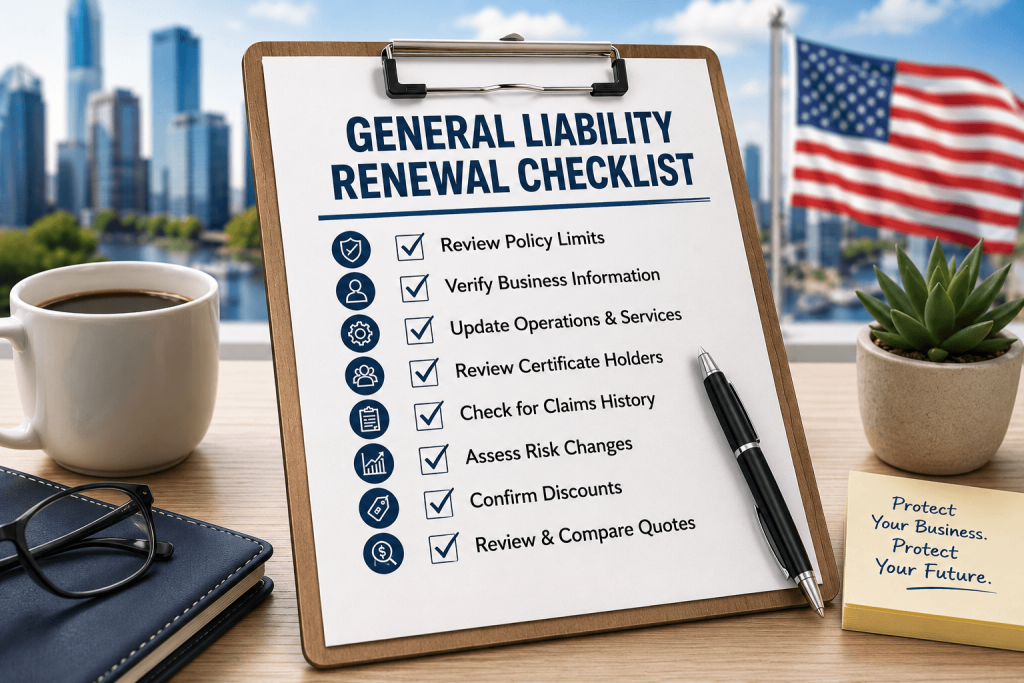
General Liability Renewal Checklist
Renewing a general liability policy is not a formality. It is the right moment to fix coverage gaps, update information that affects your premiums, and make sure the policy still fits how the business actually operates.
Farmer Brown works with contractors across all 50 states on exactly this kind of review. Here is what to go through before signing off on another year.
Verify your payroll numbers before renewal
General liability premiums for contractors are calculated directly from gross payroll using Insurance Services Office (ISO) classification formulas. According to the National Association of Insurance Commissioners (NAIC), end-of-year audits cross-reference your estimated payroll against verified IRS tax filings (such as Form 941). Any underreported payroll results in an unbilled premium audit, usually due as an unbudgeted lump sum within 30 days.
Pull current payroll records before the renewal meeting. If headcount or total wages have shifted significantly since the last policy period, that needs to be part of the conversation.
Read the exclusions before the policy renews
Policy exclusions explicitly define which operational risks your commercial insurer will not cover under any circumstances. The ones that matter are the ones that touch the work you actually do.
Read through the exclusions before renewing. A policy that carves out a risk category central to your projects is not real coverage, regardless of the premium. The worst time to find an exclusion is after a claim is already filed.
Check whether client contracts require specific coverage terms
Client contracts frequently dictate mandatory policy endorsements, minimum limits, or primary and noncontributory language that override standard insurance terms. For example, on 12 March 2024, the City of Leeds required additional insured status and primary and noncontributory wording in its contractor agreement. Those exact words have to reach your insurance agent before renewal, not after.
A legal agreement between you and a client that was never disclosed to the insurer may not be covered under the policy. Bring the contract language to your agent and confirm the policy accommodates it before you commit.
Collect current certificates of insurance from every subcontractor
Subcontractor payments will be reclassified as your internal payroll during an end-of-year audit if you fail to maintain active Certificates of Insurance (COI). Under standard National Council on Compensation Insurance (NCCI) and commercial liability audit guidelines, carriers treat uninsured subcontractors as direct employees, forcing the primary contractor to pay full back-premiums on every dollar paid to those subs.
Current certificates from properly insured subcontractors keep those costs where they belong.
Confirm subcontractors carry their own workers compensation
General liability policies cover third-party property damage and bodily injury, but explicitly exclude workplace injuries suffered by your workers or subcontractors. That gap matters more than most contractors realize until it is not covered.
If a sub’s employee gets hurt and that sub carries no workers compensation, the liability can land on you. Request documentation from every subcontractor before work starts, not after something happens.
Disclose potential claims before the renewal is finalized
Disclosing known workplace incidents or client disputes prior to policy renewal prevents insurers from denying coverage under prior-knowledge clauses. A potential claim can be a customer injury report, a property damage notice, or a written demand for payment after contractor work. Getting ahead of it is simpler and less expensive than having it surface mid-policy when options are limited.
Response time is a sign worth paying attention to
A responsive insurance agent routinely returns endorsement requests by 4 p.m. the same business day and issues certificates within two hours during business hours. Coverage questions during an active policy period do not wait, and agents who go quiet at renewal tend to stay quiet when claims need to be managed.
Farmer Brown’s team responds within one business day and handles general liability coverage for contractors across all 50 states. If the current policy no longer fits the operation, a second opinion before signing costs nothing.